Monday, February 4, 2013

Who is driving force behind anti-Israelism in Turkey?

As many believe, it is not Foreign Minister Ahmet Davutoğlu who is a driving force behind anti-Israelism in Turkey. He is too much intellectual for that.

His recent remarks on Israel where he openly urged Syria to retaliate has been considered as “irresponsible” by some, including Steven A. Cook. Cook said in his latest blog post that Turkish foreign minister’s recent statements regarding Israeli air raid in Syria “are nothing short of irresponsible.” He added that his remarks only increase tension between Ankara and Jerusalem, further removes Turkey from regional diplomacy, and contributes to an unstable environment in the Eastern Mediterranean.

Cook could have saved his valuable time by considering Davutoğlu’s remarks as made by someone who will not miss any opportunity to bash Syria’s brutal regime by pointing out the fact that Syrian President Bashar al-Assad’s army is only powerful enough to kill defenseless civilians and not confronting Israel.

Cook’s anxiety is needless at best. Today, Davutoğlu is the last person Assad would listen to. Putting this aside, however, there is one thing true in the region today: Most of Turkish leaders’ speeches on Syria and Israel is to give a wake-up call to the world to act against the recklessness of these governments. While speaking, Turkish leaders sound like fundraisers or activists rather than statesmen.

Turkish leaders have already passed that point of being “responsible” in their remarks because they failed to walk their talk for a long time now and whatever they say are not regarded as a policy item. They could not match their rhetoric not because they were ignorant of their country’s clout but for the reason that they had faith in the strength of their soft power. They sincerely believed that they could nudge region’s authoritarian figures into a right direction by talking. They failed. And they got emotional as they had nothing to offer as an alternative.  

In his remarks, Davutoğlu didn’t openly prod Syria to attack Israel (although he would welcome it); he was just trying to emphasize the fact that the army, which is supposed to defend the country, was doing exactly the opposite and committing crimes inside the country.

Davutoğlu is no enemy of Israel. He hosted an Israeli minister in Ankara early in 2010 and had a very close cooperation with Israelis up until the Mavi Marmara incident. He had seven years to lobby Erdoğan to sever ties with Israel but he didn’t. In Turkey, anti-Israel sentiments run high in almost every segment of the society but particularly in the Milli Görüş camp, where Erdoğan is coming from. Although he repeatedly denounced former Prime Minister Necmettin Erbakan’s Milli Görüş mentality, there are some traces left and being distasteful of Israel is one of them.

What is good about Erdoğan and Davutoğlu is that they are always open for talks and reconciliation. It just takes some time and of course, some courage. 

Sunday, February 3, 2013

Clinton’s legacy

Jonh Kerry will start working on Monday as the top diplomat of the United States and he probably read most of Clinton obituaries published in the mainstream media to see what his predecessor left for the new secretary.

But he obviously wasted his time. Although Hillary Clinton flew nearly a million miles and spent almost three months in the air, she did little tangible that could be pointed as a success. She did not solve lingering Israeli-Palestinian conflict, Iran’s nuclear standoff and the Taliban problem in Afghanistan, she could not contain Russia in its near abroad and she could not display a leadership in nudging authoritarian states to open up and become more transparent. In a nutshell, she did little to mitigate challenges the U.S. is facing and achieve a considerable breakthrough in areas that matter much for Washington or its allies.

What she did was keeping the U.S. power across the world from further deteriorating. There were six important foreign policy challenges Clinton faced in the past four years and she did very poor on all these:

1)    Israeli-Palestinian conflict. Clinton’s grade: - 5

2)    Arab Spring. Grade: 1 (For not succumbing to hawks for intervention)

3)    Iran’s nuclear standoff: 1 (For marshalling international sanctions against Tehran)

4)    Relations with China: 2 (For displaying resilience against N Korea’s provocations in 2010 and weaning Myanmar off China’s orbit)

5)    Relations with Russia: -1 (For making matters worse than where they were four years ago)

6)    Afghanistan: -1 (For unnecessary surge)

On the Israeli-Palestinian front, things are worse than where they were when Clinton started her tenure and the prospects for a two-state solution is almost dead for two reasons. First, there has not been any Israeli administration since 1967 that avoided expanding Jewish colonies in the West Bank -- or what the world calls “settlements” -- and agreed to a viable and armed Palestinian state living side-by-side with a secure Israel. Second, realities on the ground make it extremely difficult for the establishment of a Palestinian state. 

With respect to the Arab Spring, Washington did what it should have done. It led from behind in Libya, where interests of its allies were at stake. It took a cautious approach in Tunisia and Egypt and it did not rush to the judgment in Syria and put much of the burden on the shoulders of regional powers such as Turkey, Qatar and Saudi Arabia. Arab Spring was not an American invention and for this reason the U.S. deserves no credit on that. But Clinton’s virtuoso diplomacy in dealing with the uprisings in the Arab world deserves plaudits.

On Iran, Washington is too weak to face public opinion at home – where diplomacy with Iran means compromise -- in having direct talks with Tehran. This and some other factors put the Iranian nuclear standoff into a standstill while Iran continues with the uranium enrichment and fears of surprise Israeli attack looming large in the offing. But Clinton could boast for marshaling international alliance in putting unprecedented pressure on Iran to give up its suspected nuclear program.

Although Clinton last year announced a new U.S. policy of Asia pivot, hardly she did anything to advance this policy. When North Korea torpedoed a South Korean ship killing several dozen soldiers and shelled an island in 2010, the U.S. stood firm by Seoul and Clinton did a superb job in sending a message to both North Korea and China that U.S. did not abandon its Asian allies. Clinton also was successful in offering some goodies for Myanmar to wean it off from China’s orbit.

Initially, it seemed Washington could clinch a beneficial deal with Russia with US President Barack Obama’s “reset” policy in the face of common interests they share and threats they face. But there are a number of areas where Russia and the U.S. differ. The biggest of them are NATO’s expansive policies, anti-missile program and differences on issues related to the Arab uprisings.

Afghanistan has been a total failure for the Clinton administration as they have achieved nothing by putting more American lives in danger and begging its allies to send more reinforcements. Obama and Clinton's troops surge in Afghanistan could be regarded as one of their biggest foreign policy blunders. It effectively buried any possible peace talks with Taliban and pushed the insurgents to point more guns at Americans and their allies in the war-torn country.

In general, Clinton’s lack of initiatives in a variety of foreign policy issues prevented Washington from losing its interests at a time when US clout around the world is deteriorating. Obama’s predecessor, George W. Bush, invaded Iraq, alienated Russia and China and took a stricter pro-Israeli line among others that only increased anti-American sentiments around the world and damaged U.S. interests in many places. This is what Clinton administration did not. Advancing U.S. interests in a multipolar world is riskier than it was during the Cold War. And doing nothing -- as Clinton administration did -- is the best option Washington could do.

Friday, February 1, 2013

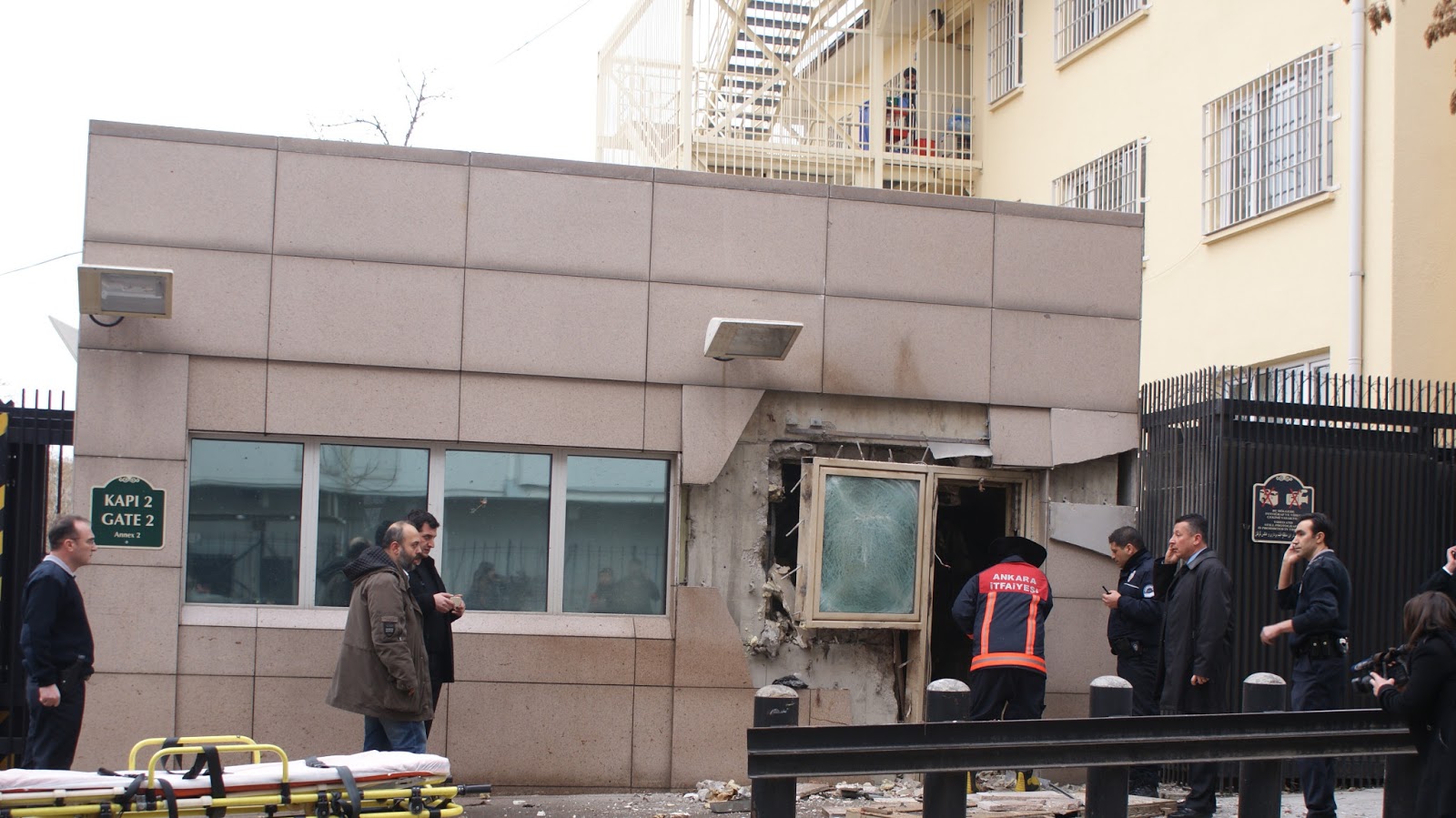
US embassy bombing: Marxism or Assadism?

Suicide bombing in US Embassy in Ankara is confirmed to be carried out by an extreme left-wing terrorist organization that has been active in the past few months as the Turkish government has stepped out crackdown on the group.

Considering that the organization is part of the a global Marxist resistance front that usually wields violence in its acts, it should not caught anyone with a surprise that they want to make headlines by the latest attack. As a matter of fact, there is a particularly troubling picture in Turkey with respect to the activities of this organization and the security situation could get worse if authorities overlook the threat of this militant group.

In past seven months, the Revolutionary People’s Liberation Front/Party (DHKP-C), the organization that carried out the US Embassy attack on Friday, carried out at least a dozen deadly attacks in Turkey. One of the attacks in Sept. 12 last year killed a police officer in Gaziosmanpaşa district of İstanbul and could make it into US President Barack Obama’s UN speech in September last year.

The organization usually picks members with terminal disease and makes them a suicide bomber. The Ankara bombing bores the exact hallmarks of a DHKP-C attack – a low profile attack, in which a suicide bomber blews himself up at a checkpoint and usually targets security.

One of the reasons why the Marxist organization targeted the US embassy in Ankara could be a violent response to the government’s increased crackdown on the organization. Police detained nearly 100 members of the organization last month and at least 55 members remain in jail pending trial. Police seized documents in raids last month, where they planned assassination of politicians, judges, prosecutors and public figures. And, yeah, what does make bigger news than bombing a US embassy?

The attack also came a day after Syria and Iran vowed retaliation against Israel following its raid on a Hezbollah-bound military convoy on the Syrian-Lebanese border. There is little evidence, if any, to back up this argument but nothing should be ruled out by a regime that desparately tries to remain afloat.

Wednesday, January 30, 2013

Botched kidnapping: Assad's men in Turkey


Turkey’s state-run Anatolia news agency reported on Wednesday that four Syrians stormed a house in southern Turkish district of Antakya, tied hands of a Syrian opposition figure and attempted to get him back into Syria.

Thankfully, they failed to escape as police clashed with them in a forested area near the Syrian-Turkish border, injuring two and capturing three of them.  

I have no idea why on earth would you risk four of your men to take a dissident lawyer back to the country while there is so much going on inside. Putting this aside, it is surprising how the kidnapping has been done in an amateur way. In such kidnappings, one or two men would do the job. It would be easier if they just knocked the lawyer out instead of tying his hands. In addition, when they left the house, inexperienced Turkish police followed their cars – something they could avoid easily.

Working with Turks on the ground is also dangerous because you never know who could be working for the Turkish police.

If the Syrian regime wanted to get rid of the lawyer, they could infiltrate into Turkey and assassinate him easily, without anyone noticing.

It is amazing how this job has been done in an amateur way. May be the Syrian regime has run out of experienced agents. If not, this is a clear evidence how people loyal to the Syrian regime use brute force to implement what they think is right.

Monday, December 17, 2012

Morality disease in Turkish foreign policy

Personal political wrangling is running so high between Turkish Foreign Minister Ahmet Davutoğlu and main opposition leader Kemal Kılıçdaroğlu, with the latter bringing down the level so down that even news agencies had to censor the offensive remarks. The debate is all about morality and the shocking news is that the entire theatre is all redundant.

Unable to find an agenda item to slam the government, Turkey’s main opposition party, with strong links to the Turkish version of Alawites, has put Turkish main foreign policy maker Davutoğlu on the target in the hope of scoring domestic political gains. Davutoğlu is one of the few politicians in Turkey who holds a PhD degree and is regarded as a very intellectual man. His command of the Turkish language is perfect and I would say he is one of the best among politicians in speaking a good deal of Turkish. But according to Kılıçdaroğlu, brain of a bird is better than his.

Davutoğlu also deserves the blame. He has put too much emphasis on his government’s foreign policy being “moral” and “principled.” He always confronts arguments and criticisms levelled against his government that are accusing his foreign policy establishment of being hypocritical behaving differently for various situations. In an attempt to be consistent, Davutoğlu and co. were very good in twisting any situation to sound moral and ethical. For someone who claims (and, sadly, believes) that the country’s foreign policy is putting “human at the center of the foreign policy-making,” being hypocritical, inconsistent and supporting non-democratic regimes elsewhere is a suicide.

I have a small tip to both politicians: Quit petty talk. No foreign policy-maker needs to be moral in his/her conduct of the foreign policy. National interest must be at the center of the country’s behavior abroad and with other countries. A diplomat or a foreign minister cannot sacrifice nation’s interest just to be consistent and “principled.” Sometimes world events push politicians to be ruthless and force them ignore many abuses of human rights and dignity because this is what state interests require.

It is easy to be an activist advocating a certain agenda. But a good politician is the one ready to flip and flop as his/her country’s interests shift.

Saturday, December 15, 2012

Anti-Islam sentiments in Egypt counterproductive to healthy transition

Fall and power-sharing struggle among a unified opposition that orchestrated a revolution is inevitable almost after all massive political transformations. What would be devastating for the future of a country is that the power struggle in the post-revolution period becomes violent and one party comes out victorious.

Emboldened by tandem electoral victories and enjoying a simple majority, Islamists in Egypt feel that they should be the one commanding the terms in writing the country’s permanent constitution. Egypt’s draft constitution, which will be put on referendum on Sunday, is far more democratic than the one it is replacing despite serious shortcomings. But Egyptians in Tahrir didn’t risk their life just to replace Mubarak-era constitution with the one that contains vague articles that are open to various interpretations.

Egypt’s draft constitution, which will most likely be approved in today’s referendum, does not include a clear set of rules on civilian oversight of the military. It is a move by Islamists not to irk the military in their delicate strides to complete the painful transition process.

For weeks, opponents of Egyptian President Mohammad Morsi protested the draft constitution, the president’s now-defunct immunity decree and even what they call possible “Islamization” of the country in the future. Protests met with demonstrations by supporters of Morsi, a rare occurrence.

Damaging the entire anti-Morsi movement is their blatant anti-Islam sentiments. Members of their group often cite “former Islamists” or “pious Muslims” confronting Morsi as an indication that the movement is not an anti-Islamic group. When they accuse Morsi and his supporters of turning country into an Islamic state, they alienate those who would otherwise be protesting against the president if the movement was not about staging open attacks against Islam’s larger representation in public institutions and in laws.

For conservative Egyptians, the struggle against Morsi is not about more freedoms or rights but a fight of those who fear of being in a disadvantageous position once Morsi finalizes the “Islamist” transition period. The result would be the Islamist president, Islamist parliament, a military backing an Islamist establishment and slowly Islamization of the country. These fears were exactly the experiences of the Muslim Brotherhood under the iron fist of Mubarak for decades. When they have a chance, they want to use it.

Islamists will make horrible mistakes on the way of writing new rules of the country. But when accusations are made on grounds that they are marginalizing secular people and non-Muslims deliberately, then the Morsi camp will be getting bigger by the addition of all who think the criticisms are not against Morsi and his circle’s anti-democratic measures but against him being conservative president.

Saturday, December 8, 2012

Does Russia matter in Syria anymore?

Desparate world powers, in an attempt to behead the Syrian regime, tried many ways they considered effective in nudging Syrian president Bashar al-Assad into quitting. All of them failed miserably.

Diplomatic overtures to end the bloodshed in Syria could be regarded as one of the most laborious, multi-lateral and the longest diplomatic talks to halt a civil war in the history. Initially, the European Union, particularly the U.S., held direct consultations with the Assad regime earlier last year, with U.S. Congressman Dennis Kucinich visiting Damascus to urge Assad to unclench his fist while responding to mass protests across the nation.  Then the duty fell on the shoulders of regional countries, mainly Turkey. While intense negotiations were under way, Ankara was angered by Assad’s what it said “blatant lies” and hence dumped the Syrian president. The Arab League took the flag but gave it up by February this year after failing to achieve any tangible progress. Then joined the United Nations, appointing its former chief Kofi Annan. That initiative, too, ended in failure.

In the course of the failing Syrian diplomacy, when the U.S., Arab nations and Turkey refused to hold dialogue with Assad, they then turned to states who threw weight behind the Assad regime and considered them effective actors with tremendous leverage in Syria. Neither of them had success in ending the 20-month violence in Syria. 

Today’s fashion is to pin hopes on Moscow. Many states, particularly Turkey, fixed their gaze on Russia, saying that, in the words of Turkish foreign minister Ahmet Davutoglu, Russia holds the key to the Syrian crisis. Ankara reiterated its position on Russia’s role earlier this week, asserting that it is Russia, not Iran, what mattered most when it comes to Syria.

One reason why Turkey is too hopeful that Russia’s involvement could change things on the ground is because Russia veteod several UN Security Council resolutions it deemed biased against the Assad regime. It was partly because Russia felt fooled by the Security Council members when they endorsed a resolution last year that eventually swept Libyan leader Muammar Gaddafi out of power.

I don’t want to think that Turkey naively believes that the UN Security Council will bomb Syria the next day after Russia changes its mind and votes for the Syria resolution. But there is no indication to think otherwise.

Another sign that Russia is not a hope at the end of the tunnel is the latest U.S.-Russia talks on Syria. The U.S. and Russia held talks this week to find a way to resolve the Syria crisis but Russia was too skeptic, with its foreign minister saying that there was only a slim chance that the leaders could come out with something that would wind down the escalating conflict in Syria.

Instead of pinning hopes on Russia, spending too much energy on proding Moscow to change its position that will only make it feel emboldened, Turkey should divert its attention to elsewhere if it wants to see Assad leave soon.

Saturday, December 1, 2012

What if Iran goes nuclear?

Political wrangling between the U.S. and Iran over the latter’s suspected nuclear program has become less visible than a debate between those who believe a clear cut red line should be drawn before Iran and those who think Iran’s threat is hyper-inflated.

Henry Kissinger reinforced with his recent op-ed in the Washington Post calls on the U.S. government to take the Iran’s alleged rapid drive to acquire a nuclear bomb seriously as it will have profound consequences in the region that are detrimental to interests of the U.S. and its allies. He said the result of Iran going nuclear will cause an “essentially uncontrollable military nuclear proliferation” throughout a region.

He added that countries within the reach of Iran’s military but lacking a nuclear option would be driven to reorient their political alignment toward Tehran. Another setback, according to Kissinger, would be that the reformist tendencies in the Arab Spring would be submerged.

Stephen M. Walt is on the other side of the camp, favoring to cool down the rhetoric against Iran, which he thinks could be key in urging the Islamic Republic to abandon its suspected nuclear program.

He says nuclear proliferation in the region as a response to Iran’s possible development of a nuclear bomb is not what history teaches us would happen. He brings the example of Israel, South Africa (which gave up its small nuclear arsenal later) and North Korea, whose neighbors did little, if any, to go nuclear as a response.

He also dismissed Kissinger’s arguments that countries adjacent to Iran would surrender to Iran’s emboldened clout with nuclear weapons and will choose bandwagon. His example was from the Cold War, when Soviet’s nuclear threat only made NATO allies more cohesive.

Walt also believes that possessing nuclear weapons won’t prevent “reformist tendencies” to disappear as the Soviet Union's huge nuclear arsenal did little to crush massive, tandem uprisings in Eastern Europe, which eventually also brought down the Soviet Union itself.

Kissinger is right to suggest that Iran’s nuclear weapon would trigger mushrooming of nuclear weapons in the region. Realists wouldn’t be surprised to see other nations trying to re-establish their deterrence capability by developing weapons similar to what their adversaries have. The reason why Japan and South Korea didn’t attempt to build a nuclear bomb is because they are already under the nuclear umbrella of the U.S. North Korea’s building of the nuclear bomb was not an aggresive but a defensive step to protect itself from the U.S.

The case of India and Pakistan was also misleading. India’s nuclear bomb was perceived by every state in the region to be solely against Pakistan. But Iran’s case is different. Iran is not only trying to equalize its military power with Israel but also sees Turkey and Sunni Arab states as its adversaries. No state is assured of Iran’s incentives. Turks and Arabs won't consider Iran's nuclear bomb to be only aimed at Israel but to their countries as well.  

Kissinger made a wrong argument when he said some states, particularly Bahrain, could bandwagon if Iran goes nuclear. Possessing nuclear weapons does not mean that Tehran will make nuclear threats to make its neighbors bow to its pressure. Taiwan is one shining example.

Theoretically Walt is correct that regional states won’t bandwagon Iran. But his example suggesting that NATO’s European allies balanced against the Soviet Union instead of succumbing to the looming Soviet threat is misleading at best. States usually bandwagon to save their country from being occupied and destroyed or to save the regime it is being ruled by. None of them would be possible if European countries chose to stay in the Soviet camp. Few Soviet allies were ruled by non-communist leaders but they still were strictly socialist, militant authorities with anti-Western agenda such as Syria and Iraq.

For the last argument regarding the reforming tendencies of the Arab Spring, my pick would be Walt. International politics is being run by rational actors (although Walt indicated in his previous blog post that uncertainty among states remains a powerful factor defining the international politics) not by masses. Grassroot movements and uprisings would not shun from doing what they think is right just because another state in the block has a devastating weapon.

I believe the primary issue here is not inflating the threat or ignoring it but how Israel, Arab states and Turkey are free riding America. It is not difficult to predict that Arab states and Turkey would be number one adversary of Iran once the U.S. stops efforts to contain Tehran. At a time when the U.S. needs to shut down expensive adventures abroad, sharing costs with allies would be a smart way to go.

Tuesday, November 27, 2012

Israel planned to give Gaza back to Egypt by recent bombing

As many suggested, Israel’s military operation in Gaza named “Pillar of Defense” was not about upcoming Israeli elections or Iran; it was simply Israel’s hobby and a part of its perennial goal to make Gaza a part of Egypt not Palestine.

In the course of the eight-day Gaza war, dozens of analyses appeared in mainstream newspapers and blogs, suggesting that Israeli Prime Minister Benjamin Netanyahu was garnering political capital to boost his electoral votes in upcoming elections in January. 

Arab and Turkish leaders were quick to accuse the Israeli leader of making electoral calculations at the expense of blood of Gazan children. In the words of Turkish President Abdullah Gül, Netanyahu was making “a bloody electoral investment.”

Differential analyses resurfaced in some media outlets, including the New York Times, citing US and Israeli officials as saying that the Gaza operation was a mini model of a possible Iran operation in the future and constituted war games to observe how the nation was prepared to long-range, much more dangerous Iranian rockets no doubt would start showering on Tel-Aviv in case of an armed confrontation.

The claim that Netanyahu was bidding for reelection with its Gaza operation is plain wrong. No leader would take the risk of starting a war with unknown consequences unless he knows that it is a matter of political survival and that he has nothing to lose not going down the path. Netanyahu and co. are well aware that the prime minister will easily win in the January poll.

In addition, Netanyahu is not ruling the country alone. The Gaza operation was planned and implemented by the coalition government. Coalition partners – Netanyahu’s rivals -- would not pave the way for the prime minister to get one step ahead of them in the election in two months.

There was also very little, if any, criticism from inside Israel, that would put pressure on the government to halt the Gaza operation. A recent survey published by the Haaretz revealed that striking 84 percent of Israelis were backing the Gaza operation. This is a clear evidence that few in Israel believe that Gaza operation was Netanyahu's electoral calculation.

Claims that Gaza operation was about a future attack on Iran’s nuclear sites also have many fallacies. Israel doesn’t need hundreds of rockets to be fired into its territory to see how its rocket interceptors are working. There is a thing called “military drill.”

Many analysts slammed Israel’s Gaza operation for being a futile attempt to stem rocket attacks from Gaza and argued that the military offensive doesn’t add to Israel’s security. They are right. But it was not Israel’s goal to launch a wide offensive to stop few harmless rockets. 

All these speculations helped Israel cover behind its primary goal, not secret to anyone anymore, which is to bury two-state solution and making realities on the ground even more incompatible for an independent Palestinian state. An important part of this plan is to tear Gaza and West Bank apart, make two peoples living there feel alienated and more importantly to make Gazans consider themselves a part of Egypt rather than Palestine.

Giving Gaza back to Egypt will help Israel get rid of nearly 2 million Palestinians, a huge favor for a bi-national Israeli state threatened by a growing number of Palestinians.

The plan seems to be working: The U.S. praised Egypt for its role in mediation. Israel okayed Egypt’s staunch backing of Gaza and agreed to see Egypt a guarantor of the Gaza truce.

“We don’t trust on Israel but we trust on our Egyptian brothers,” Hamas spokesman told a TV channel after the ceasefire was agreed. This was the sentence Israel wanted Hamas to say. 

Monday, November 5, 2012

Erdoğan’s lira zone: Nationalism or economy?

Turkish Prime Minister Recep Tayyip Erdoğan has plunged Turkey’s agenda into another useless debate in which, no matter how much less sense the idea makes, his supporters threw weight behind it.

It came in Berlin, where Erdoğan said Turkey will not join the eurozone once it is the member of the European Union, in first such a public proclamation by a high-level Turkish official. He proposed Turkish “lira zone” to emphasize confidence of neighboring countries in Turkish economy and an implicit comparison between Turkish economy and the eurozone economies.

No doubt Erdoğan’s statement is a clear expression of his nationalistic views rather than a thought-provoking economic idea that could help find a solution to Turkey’s deepening crisis in closing gaps in current account deficit, growing cleavage of export-import imbalance and high energy costs that in turn makes virtually everything in the country more expensive and thus drives up already soaring inflation.

Erdoğan attacked the euro as the chief culprit of the economic crisis in the southern belt of the eurozone and overlooked the significance of “zone” that shares most of the eurozone’s woes. His proposal to create another zone is a clear evidence that he sees the euro as a currency being sick not the eurozone.

Euro remains one of the strongest and most stable currency in the world. Although it is not as much used in financial transactions across the globe as the U.S. dollar, many countries still view it reliable to hold large reserves of euro as foreign currency as a way of stabilizing their economy.

The primary problem at the heart of the eurozone crisis is that the area has one currency with many fiscal policies and countries that are in deep recession like Spain and Greece have hard times in digesting top-bottom austerity policies imposed by heavyweights like Germany and France upon them.

Erdoğan’s proposal to create a Turkish lira zone has little if any benefit to Turkey’s economic woes. Turkey could create strong Turkish lira only by abandoning protectionist measures that will also set away its current account deficit problem. It could hence create strong Turkish lira that might be used in neighboring countries as the third currency. It could export more Turkish lira from its economy to neighboring countries if need be but avoid imposing on countries to adopt Turkish lira as their national currency. That would be the mistake the EU made a decade ago.

Except Iraq and Azerbaijan, most countries in Turkey’s vicinity that could be likely candidates to adopt the Turkish lira import more than their export. It means they will constantly keep exporting their foreign currency reserves. This is another reason why Turkish lira would be in worse crisis once neighboring countries keep using it.

There is a reason why American dollars remain the king of currencies. It is because it is being used only in one country, which is democratic and has very vibrant, liberal economy.

Wednesday, October 31, 2012

How to bypass spending in FP: Make others do your job

Only days left to the key U.S. presidential race and one wonders if the U.S. foreign policy will make a significant shift in case either candidates get to the White House. This is hardly the choice the U.S. president will make in the middle of painful economic recovery.

The biggest challenge faces the U.S. abroad is not Iran driving to acquire a nuclear weapon or China that is building huge economy and military muscle. It is its own economy that is having hard time to find necessary money to fund its foreign policy establishment and military – key for conducting an effective foreign policy.

The reason why the U.S. economy is recovering so slowly is because the Obama administration, departing from tax cut policy for increased production the federal government had been pursuing since 1981, has started spending on budget deficit, coupled with expensive Health Care spending that is signed into law in 2010. The price tag of entitlements – public spending Washington can’t give up – will become much bigger burden for taxpayers as the U.S. enters into a new era where aged people will fast close the gap with younger, working generation thanks to the fact that 1946-1964 “baby boom” generation is turning to 65. One of them is U.S. Secretary of State Hillary Clinton. The U.S. will have to shrink its military spending, foreign aid and an array of foreign policy initiatives it is implementing thanks to these spending.

There is a very effective way for the U.S. to overcome this troubled trend in economy that will squeeze its foreign policy spending: Make others do what you had been doing all along.

Broadening close partnerships with allies, eliminating possible threats and avoiding expensive initiatives such as Iraq quagmire is going to make up the backbone of the U.S. foreign policy moves. Washington’s limited options vis-a-vis Arab countries demanding transformation of their nations have already showed to what extend the U.S. could reach in realizing its goals.

At least in the next four years, the U.S. will work more closely with allies and share costs with them in national security challenges. “Leading behind” policy in Libya, working closely with Turkey and Qatar in the Syria crisis and establishing a broad coalition of states to impose crippling sanctions on Iran are policies the Obama administration was successful in pursuing that saved it billions of dollars.

No matter who wins the White House in this November elections, the new president will have to work more with allies to share costs abroad. The new president will face growing budget deficit and more burden on taxpayers. Although Romney vows to increase military spending despite economic challenges, it is hard to believe that he will go that path along. Cutting military spending will hardly change the conduct of the U.S. military around the world because the waste in the U.S. army is rampant. In these circumstances, it is not hard to estimate that the U.S. will choose to work more with allies, avoid costly adventures abroad rather than playing solo.

Wednesday, October 24, 2012

States need U.S. partnership not leadership


U.S. presidential candidates, in their final debate on Monday that was focused on foreign policy, made it clear to their voters that they will be better presidents in leading America in key parts of the world without knowing what kind of negative consequences it might entail. 

One wonders how the next president is going to make it happen giving constraints of the U.S. power following two devastating wars in the Middle East and numerous falling initiatives. In the debate, Obama used the word “leadership” for 15 times while Romney said it eight times. It certainly brings votes to say America is going to lead the world to peace and prosperity but at the same time it creates discord in various parts of the world against the U.S. role.

No state can accept leadership of another state unless it is under grave threat of destruction and any attempt to create leadership over others has always had backlash. There is no such thing called “American leadership that will bring peace and prosperity” as Romney kept repeating in the debate. States, as usual, will always keep fighting and the U.S. must pick a smart strategy to turn the tide into its favor. This could include pitting emerging powers against each other to make sure that no nation is dominating others in a region they are located. Another strategy is to make brief intervention to change the course of events rather than trying to run a country. The U.S. is good at changing the course of history but it is bad at running other nations. 

When you boast of a military spending that is more than military spending of next ten countries combined, then you should be ready to see other countries worried about your military might and intentions.  The U.S. is the most powerful nation on Earth and it can defeat any state it wants in any part of the world. When this kind of tremendous power shows signs of leadership role in any regional challenges it faces, it will be met with resistance rather than welcome. States will only welcome the alliance and partnership of the U.S. as long as they know that the U.S. has no expansionist ambitions. 

When you talk about leadership in the East Asia, this is definitely not good news for both China and its adversaries. The U.S. must continue to leave nations surrounding China weak to the extent of being only defend themselves to make sure that Japan and other states don’t dominate the region as it was the situation before the World War II. The U.S. should stay vigilant against Chinese expansion as well as maintain the current balance of power in the Pacific region with delicate partnerships rather than speaking about being a leader in the region. 

The same goes with the Middle East too. Neither Turkey nor Egypt want U.S. leadership but both powerful countries wouldn’t want to see their ambitions being realized without the U.S. giving a helping hand to them.

All in all, the U.S. will continue to increase its presence in the Middle East and East Asia no matter who will be elected to the White House. But the U.S. should aim to prevent any state to dominate regions that are very significant to U.S. interests, including its own domination. Taking a leadership role in the Middle East and the East Asia won’t help Washington to promote its interests and instead will turn friendly nations balancing against the world’s superpower.

Saturday, September 1, 2012

Why no one cares about Syria safe zone

For most part of the uprising, the entire world has stared at Turkey’s mouth to see if Ankara spells out a possible buffer zone inside Syria that would be a safe haven for the armed opposition. Today, Turkey demands it but no one cares.

I’m not particularly surprised to see such a situation develop because states rarely act when the issue in question is humanitarian. Insistently clamoring for a “liberated territory” in Syria was largely driven by a success in Libya where eastern city of Benghazi, the heart of the Libyan revolution, played a key role in organization of the armed revolution that ousted late Libyan leader Muammar Gaddafi a year ago. Absence of such a territory in Syria made it hard for the armed opposition to receive arms from outside and also establish an effective transitional government that would facilitate the diplomatic overtures abroad and coordinate armed groups inside the war-torn country.

Turkey, finally, demanded before the United Nations Security Council on Thursday to establish a safe zone inside Syria as it was inundated with growing number of Syrian refugees fleeing from the violence in Syria. Security Council, Secretary’s office and even the U.S. were reluctant to go down the path of calling for safe zones along with Turkey. “I was wrong with my expectations,” Turkish Foreign Minister Ahmet Davutoğlu told the Security Council in a disappointment.

But why are the major powers too reluctant to establish a buffer zone when there is growing legitimacy in this end and historic opportunity to aid the rebels? The answer is simple: Possible buffer zone in Syria is humanitarian and not about the revolution anymore.

The U.S. claims that the crisis has a humanitarian dimension but it is largely a political crisis because the deaths and violence are caused by the Syrian regime. European nations and the U.S. pledged little financial aid for the fleeing refugees. Washington also seems very unwilling to nod to the Turkish-French initative to establish a buffer zone inside Syria – the last thing Obama administration wants to deal with months before key presidential elections.

Journalists, activists and some states claim that the Syrian opposition control large swathes of areas on the Turkish border, creating a de facto buffer zone, which also leaves outside help in this regard largely unnecessary. Any military intervention by NATO or by the coalition of the willing to establish the buffer zone inside Syria will do little to aid the rebels in advancing their cause and instead will create additional strains with Russia, China and prompt unexpected retaliation by the Syrian government. A realist would not be surprised to see such a situation where states don’t act if the matter is solely humanitarian.

Wednesday, August 29, 2012

How not to solve Syrian crisis

Almost a month ago, Egypt's ambitious president offered a regional meeting among Turkey, Egypt, Iran and Saudi Arabia to end the 18-month violence in Syria and reiterated his initiative earlier this week.

Iran welcomed the suggestion while Turkey said works are underway to elaborate Egypt's proposal on holding the regional meeting. If Saudi Arabia nods to such a meeting, it will be the only high-level Syria meeting that includes Iran, which is the staunch supporter of the Syrian regime, whose ruthless crackdown on the armed opposition has caused the death of more than 20,000 since the uprising started in March last year.

Former American diplomat and an academic Vali Nasr said in his recent The New York Times op-ed that Iran's inclusion in Syria talks is important as it has great leverage in Syria. His view was dismissed by many who contended that Iran is the chief architect of violence in the war-torn country and that Tehran is a part of the problem rather than a solution.

While David Kirkpatrick of the NYT has suggested that Morsi's recent initiative shows that Egypt will be picking a new, independent trajectory without the U.S., Today's Zaman's Bülent Keneş likened Morsi's foreign policy steps to Turkey's what he said "adventuresome" foreign policy it pursued earlier in the past decade. Speaking as if unaware of regional realities and of too much antagonism between Iran and Saudi Arabia, Morsi told Reuters in a recent interview that the balance is key in international relations and that he wants to achieve this goal by reaching out to every actor in the region.

It is obvious that the crisis in Syria is now what many call a "regional crisis," becoming the battleground of influence between Turkey/Saudi Arabia/Qatar and Iran/Russia. If a regional solution to the crisis is possible, it will only be achieved if all actors involved in the peace talks have a genuine desire to end the bloodshed as a first goal rather than advancing their influence inside Syria.

One would expect that a realist would favor fighting to oust the Syrian regime that would deal a huge blow to Iran. But a realist does not only do everything that is in the interest of a state but also calculates all costs and benefits. Getting Syria out of Iran's orbit isn't worth to a bloody and very costly war. In addition, there are better ways of doing it.

Ending the bloodshed in Syria, it seems, is not what Iran wants and hence it will be a likely outcome that the quartet talks will collapse. Both Turkey and Iran, fierce rivals in Syria, claimed that a side they back is closer to "victory." This thinking will also make it almost impossible for actors to make compelling compromises.

With these realities on the ground, Morsi's initiative for the regional meeting on Syria is naive at best. In stable Syria, Turkey would be the winner as it was very successful in getting Damascus out of Iran's orbit before the uprising started last year. Wary of this situation, Iran could hardly consent to a scenario of stability in Syria at the expense of the Syrian regime.

Thursday, August 16, 2012

Turkey's incompetence in Syria


How can a country claim to be the Muslim world's moral police and "central state" if a rogue regime's warplanes are killing men, women and children only 3-4 miles away from its border? How can a country reiterate for too many times that it cannot remain indifferent to unceasing violence in its neighbor and yet do nothing when it can?

When critics blast Turkish foreign policy establishment for remaining impotent to unfolding crisis in neighboring Syria, Turkish diplomats are almost always on the defensive: It is Syrian president who did this.

Syrian regime was more friendly to Turkey than any of its neighbors, including Iran for several years. It did little, if any, to outrage Turkish people and its government in the course of the uprising in the country that has now left more than 20,000 dead. Syria regime is brutal, ruthless and it is using indiscriminate force against opposition fighters as well as civilians. But it was careful in not angering Turkey in early months of the uprising.

Turkey had a tremendous leverage both in Damascus and among rebels - an ability neither Iran, Russia or the U.S. had. But it did little to listen Assad's grievances and kept reiterating that Syrian army must stop the crackdown. Turkish Foreign Minister Ahmet Davutoğlu met with Assad for 6 hours on Aug. 9 last year, urging the president to stop the military operations in Hama and Homs. Davutoğlu was right. But he failed to estimate that his deal with Assad would fall apart if the armed opposition staged a single attack, prompting Assad's reprisal.

Instead of maintaining diplomatic track in the hope of nudging Assad into a right direction, Turkey believed that joining in an international coalition determined to isolate Syria would work. It didn't. It miscalculated Assad's power and hoped (and still hopes) that he will leave very soon. He did not.

Let's imagine that Turkish government acknowledged its mistakes but wants to move forward to salvage the situation. For a better outcome than the current situation, Turkey should not only focus on toppling Assad but also prepare for what comes next. Syria is a divided country and transition from dictatorship to democracy seems to be bloody. As it is evident that it is impossible that Turkey could tolerate any transitional regime that Assad is a part of, Turkey must speed up efforts to oust the Syrian president and while doing so, it must send a message that its policies in Syria is not sectarian.

Frequent messages by both Turkish foreign minister and other Turkish officials that Turkey's foreign policy in the region is not sectarian is a clear example that people living in the neighborhood perceive Turkey's policies to be based along sectarian lines. Turkey claims it is supporting only good people and it turns out that the good people, according to Turkey, are most of the times Sunnis.

There are many things Turkey could do to protect civilians while trying to get rid of its ex-friend. One of them is to prevent the increasingly bloody war being waged by the Syria air force in areas close to the Turkish border. In Azaz, only several miles from the Turkish border, Syrian warplanes are ruthlessly bombing rebel-held areas in a bid to root out rebels. Dozens are killed in the air strikes.

According to initial reports, 86 Syrians wounded in the air strikes were brought to southern Turkish province of Kilis and 13 died either on their way to the hospital or at the hospital on Wednesday. This is not only embarrassing situation for Turkey, which claims to be a regional heavyweight, but it is also morally reprehensible.

Syria shot down Turkish warplane in international airspace, 5 miles off the Syria's air space. This is a strong evidence that Syrian military deployment beyond Aleppo up to the Turkish border is a clear threat to Turkey.

Turkey must immediately demand Syria to withdraw all its heavy weapons from areas close to Turkish border and issue a warning that its air force must land warplanes flying close to the Turkish border and bombing civilian areas. If Syria does not comply with Turkey's ultimatum and continue bombing residential areas on the Turkish border, Turkish jets must shoot down some of the Syrian warplanes without hesitation.

Don't worry Turkey, I made a little search and found that dozens of planes were shot down by another state without receiving any retaliation.

Monday, July 30, 2012

Calling 'bad boy' to do good deed


Different foreign policy wonks have been tossing back and forth the question of whether to ask Iran to use its tremendous leverage in Syria to find a political solution to the 16-month crisis there that has now left more than 20,000 Syrians dead.

Vali Nasr, former assistant to late diplomat Richard Holbrooke, has an op-ed in the New York Times, where he claims that the Western and Arab strategy to focus on toppling Syria's embattled President Bashar al-Assad takes that country down the slippery slope. In his view, Iran is the most significant actor in this game, which major powers ignore. Given the fact that any indulgence granted to demands of Iran has reapead a horrible harvest in the past few years, it is legitimate to ask why Tehran could possibly play a constructive role in the Syrian crisis. The article is fascinating because hardly anything claimed in the piece is theoretically wrong.

Iran is an unreliable and unpredictable country -- it takes extra caution and patience to work with this country. History shows that it would be a mistake to bet on Iran's words and pledges. Working with Iran in difficult cases such as Syria is a sure path to a room full of trouble. For years, the Western countries have worked tooth and nail to move Syria out of Iran's orbit and accused the Islamic republic of aligning with Syria in a bid to extend its influence to the eastern Mediterranean. How could now Western nations ask Iran to play a constructive role in Syria when it believes that Iran should have no business in the country? In addition, Iran blatantly backed Assad and gave no sign that it would agree to a Sunni-dominated government once the Syrian president steps down.

In Nasr's article, few of these concerns are mentioned or addressed adequately. Nasr claims that with or without Assad as its leader, Syria now has all the makings of a grim and drawn-out civil war. He argues that the United States and its allies must enlist the cooperation of Assad’s allies — Russia and, especially, Iran  — to find a power-sharing arrangement for a post-Assad Syria that all sides can support, however difficult that may be to achieve. In his view, involving Iran in any resolution to the conflict could throw Tehran a lifeline, but repercussions of prolonged conflict in Syria would have devastating consequences for both Syria and its vicinity. He then goes on in length to explain how powerful Assad's "killing machine" is and how it carries the risk of becoming another Lebanon. Nasr contends that the West has already bungled its attempt to topple Assad and he says the Western strategy of supporting opposition to oust the Syrian president is a wrong goal.

To find a way out of this impasse, Nasr offers a transition plan that includes most importantly Iran and Turkey, which he says has a military muscle to influence the conflict. According to Nasr, Iran will join in the bargain because it is not sure what will follow Assad if he exits.

Syria is a battleground between Sunni majority, backed by US allies such as Qatar, Saudi Arabia and Turkey, and Alawite minority, supported by Hezbollah and Iran rather than a fight for democracy. Why would Turkey or Iran agree to such a transition plan when each side believes that it is winning the war? Iran seems unwavering in its support and its foreign minister said this week that such a plan is nothing but "an illusion." Turkish Prime Minister Recep Tayyip Erdogan already said twice last week that rebels in Syria are putting final touches to the revolution.

Theoretically, Nasr is correct. Underlying this strategy is the view that a country, especially one which could use its political weight to shift troubling trend in another country, will most likely agree to a midway formula with which everyone would win.
But realities on the ground make it impossible to work with Iran for a peaceful solution in Syria due to regional bickering and too much antagonism between the U.S. and Iran. Besides, it is hard to imagine that Syrian rebels will agree to any role Iran would play in Syria's transitional government.

Nasr's article would make more sense if he wrote this last summer and replaced words "Iran" with "Turkey," which had enormous influence on both Syrian opposition and the Assad regime but abandoned it for reasons still can't make me sleep well.